Most people today believe that throughout history a husband had the right to beat his wife however much he wanted, that wives never beat their husbands back, and that all of this was completely accepted by society until the last sixty years or so. The truth is very different which we can see from laws, court cases, and fiction from the time.
1. Cultural Acceptance of Physical Punishment
Corporeal punishment was used far more often in the past. Jailing was not often employed because of cost and instead physical punishment was favored. The belief was that physical punishment would ensure the lesson was truly learned.
Notions of what should be considered a crime were also different. Ever hear of the phrase “disturbing the peace”? This was the standard by which crimes were considered. If a person committed an act that disturbed the peace of the community, or essentially caused grief or significant annoyance to someone else, then they deserved punishment as a way to stop that action from being promoted and it needed to be serious enough so that it would deter others.
Gossiping would get you an iron box on your head and a metal stick in your mouth so that you couldn’t speak. Thievery would get you branded with a letter T on the palm of your hand or on your forehead if it was committed on the sabbath day (quite a bit heavier than just having to sew a letter onto your clothes like Esther Prynne, eh?).
https://www.history.org/foundation/journal/spring03/branks.cfm

2. The Effect of Coverture
Until the last century or so, when a man and woman married they entered into a legal arrangement referred to as coverture. The basis for coverture was that the two persons became one under the eyes of the law and specifically that the husband became the legal guardian for his wife, “under whose wing, protection, and cover, she performs everything.” Certain factors in this legal relationship were comparable to that of master and servant and parent and child. A husband had a duty to provide necessities to his wife and to keep her within the same social status as himself in regard to clothes, housing, food, ability to afford servants if possible, etc. Most importantly for this discussion, he would be held responsible for her actions, especially criminal ones.
Excerpt from Oliver Twist by Charles Dickens, 1837:
It was all Mrs. Bumble. She would do it,” urged Mr. Bumble; first looking round, to ascertain that his partner had left the room.
“That is no excuse,” returned Mr. Brownlow. “You were present on the occasion of the destruction of these trinkets, and, indeed, are the more guilty of the two, in the eye of the law; for the law supposes that your wife acts under your direction.”
“If the law supposes that,” said Mr. Bumble, squeezing his hat emphatically in both hands, “the law is a ass — a idiot. If that’s the eye of the law, the law is a bachelor; and the worst I wish the law is, that his eye may be opened by experience — by experience.
The women who signed the Declaration of Sentiments brought up the effects of the practice as well:
“He has made her, morally, an irresponsible being, as she can commit many crimes, with impunity, provided they be done in the presence of her husband.”
An example from a court case:
“On the last day of a hot and incredibly dry June, 4 criminals appeared, bound, before the bench of London’s primary criminal court, the Old Bailey. The year was 1714. Robert and Margate Cook, Thomas Davis, and Deborah Stent were facing burglary charges. The team allegedly pulled off a pewter heist in the house of Mary Mellers the month before. Robert Cook made the mistake of bragging about the crime while Margate and Deborah were caught selling off the pewterware for cash. The stakes were high. The punishment for burglary in early modern London was death.
Without much fanfare, Robert Cook and his sidekick Thomas Davis were found guilty and sentenced to death. But Cook’s wife, Margate and her friend Deborah Stent were acquitted. Not because of insufficient evidence, or because of mitigating circumstances. But by “reason of their coverture.”
We can more easily understand this principle by reading an excerpt from Blackstone’s Commentary On The Law about this kind of relationship:
“AS for those things which a servant may do on behalf of his master, they seem all to proceed upon this principle, that the master is answerable for the act of his servant, if done by his command, either expressly given, or implied. Therefore, if the servant commit a trespass by the command or encouragement of his master, the master shall be guilty of it: not that the servant is excused, for he is only to obey his master in matters that are honest and lawful. If an innkeeper’s servants rob his guests, the master is bound to restitutions for as there is a confidence reposed in him, that he will take care to provide honest servants, his negligence is a kind of implied consent to the robbery. So likewise if the drawer at a tavern sells a man bad wine, whereby his health is injured, he may bring an action against the owner for, although the master did not expressly order the servant to sell it to that person in particular, yet his permitting him to draw and sell it at all is impliedly a general command.”
Likewise with children, parents are ultimately responsible for everything they do. If a child is rude and a troublemaker, we see it as a failing on the part of the parent because they were supposed to teach their children correct manners and proper behavior. Even if the child is naturally that way, the parent has a duty to correct them as much as possible.
So that brings us to the similar dynamic of husband and wife. When feminists talk about men holding all authority over their households in the past, they are right. Society placed equal amounts of authority and responsibility on men to run their households correctly, in the same way that a business owner is responsible for and in control of, within legal standards, everything that happens within his business. If a servant wasn’t performing his duty efficiently, it was the man’s responsibility to discover and take care of it. If a child wasn’t behaving properly, it was the father’s job to correct it. If the wife was engaging in acts she shouldn’t, it was the husband’s job to set her right. If the husband wasn’t performing his duties, which involved both the caring for, protecting, and correcting of the people under his responsibility, it was the law’s job to correct him.
Although people today may balk at the idea of a husband and wife being placed in a role similar to that of parent and child or servant and master, this is something we naturally assume when wives commit crimes today; that is, we assume that the husband was really at fault, either through his manipulation and persuasion or negligence. We are comfortable with placing people into this context so long as it means that the husband gets in trouble instead of the wife.
As much as feminists, when confronted with this practice, would like to push responsibility for it onto men and patriarchal authority over women, they otherwise advocate for the exact same treatment of women in modern times.
We are supposed to believe that this law came about from the view that women were like children and couldn’t think for themselves (which is an obviously incorrect interpretation considering that single females were not given these exemptions by the law, only married women). Yet we have this same reaction today when a woman commits a crime and a husband or boyfriend can in any way be considered as an accomplice. “She only did it because he made her.” He doesn’t even need to be a part of the actual crime, even if she did something egregious like killing her children, we assume that he drove her to it by being a negligent father and husband. Hillary Clinton herself advocated that we abolish female prisons since women only commit crimes because of men’s influence on them.
We no longer have coverture laws whereby husbands are given authority over their wives, yet when it pertains to giving women get out of jail free cards, the idea still applies. This allowance does not exist because of patriarchal norms but because of a natural tendency we have to excuse women when they’ve done something wrong and instead place responsibility for it on the shoulders of men. The fact that it still happens today is indicative of how strong that tendency is.
The situation in the past was that a man was held responsible for the actions of his wife and as such was given the responsibility and power to either avoid or deserve that blame. But today we assign men responsibility for women without any power to avoid it.
This is particularly nonsensical since we give all socially acknowledged power and decisions, when not in critique, to wives. They are the ones who generally make decisions for the family, the children, and even for their husbands. How often does a wife give the final decision on whether her husband takes a particular job or if the family will move to a new place? She decides how the children are raised and how the family is run all up until something goes bad and these things are criticized and then it all becomes the fault of the husband. His very lack of decision can be made the fault of her decision making because she had to do it all herself.
This is essentially like having a CEO who runs a company all on her own, but keeps a nice scapegoat guy to take the fall for her when necessary.
At least in the past, husbands were the CEOs and could not use their wives as scapegoats. As Blackstone said, regarding the servant master relationship:
“WE may observe, that in all the cases here put, the master may be frequently a loser by the trust reposed in his servant, but never can be a gainer: he may frequently be answerable for his servant’s misbehavior, but never can shelter himself from punishment by laying the blame on his agent. The reason of this is still uniform and the same; that the wrong done by the servant is looked upon in law as the wrong of the master himself; and it is a standing maxim, that no man shall be allowed to make any advantage of his own wrong.”
In the past, when men were in charge, they also got stuck with the bill. Today, women are in charge, right up until the bill comes.

3. Men had restrictions on what corporeal punishment they could use on their wives.
“THE husband also (by the old law) might give his wife moderate correction. For, as he is to answer for her misbehavior, the law thought it reasonable to entrust him with this power of restraining her, by domestic chastisement, in the same moderation that a man is allowed to correct his servants or children; for whom the master or parent is also liable in some cases to answer. But this power of correction was confined within reasonable bounds; and the husband was prohibited to use any violence to his wife, other than lawfully and reasonably pertains to the husband for the rule and correction of his wife. The civil law gave the husband the same, or a larger, authority over his wife; allowing him, for some misdemeanors to beat his wife severely with whips and sticks, for others, only with moderate punishment. But, with us, in the politer reign of Charles the second, this power of correction began to be doubted: and a wife may now have security of the peace against her husband; or, in return, a husband against his wife. Yet the lower rank of people, who were always fond of the old common law, still claim and exert their ancient privilege: and the courts of law will still permit a husband to restrain a wife of her liberty, in case of any gross misbehavior.
Excerpt from Blackstone Commentary on the Law
Beating with whips and sticks was the appropriate punishment for children, wives, and servants. Wives were the first to receive legal protection from this and it happened in the mid 1600s.
Sir Francis Buller, a judge in the late 1700s, allegedly claimed that husbands should still have this right so long as they use a stick no wider than their thumb, which caused a great controversy. The judge then received the nickname Judge Thumb and a famous cartoon of him satirizes the incident and demonstrates that this was rejected and ridiculed by the greater society.

“1782 caricature of Buller by James Gillray entitled “Judge Thumb, or, Patent Sticks for Family Correction: Warranted Lawful!”. Judge Thumb, carrying two bundles of sticks, one on his shoulder like the fasces of a Roman magistrate, asks: “Who wants a cure for a rusty wife? Here’s your nice family amusement for winter evenings! Who buys here?” Woman screams: “Help! Murder, for God sake, murder!” Husband replies: “Murder, hey? It’s law, you bitch: it’s not bigger than my thumb!”
Another example from a court case in the 1300s demonstrates what was acceptable as well as that excessive cruelty from a husband could get a woman a legal separation starting from that time period.
“Guilielino is a perverse and wicked person, treating his wife evilly and disgracefully from the time his wife was less than fifteen years of age by beating and striking her sharply and often with punches, and slaps, and kicks, and bludgeoning . . . and often threatening to kill her and brandishing an unsheathed sword at her. . . .Sitella then elaborated on the physical violence, saying that Guilielino “had often threatened to put her to torture” . . . that he raged immoderately at her, beating her excessively and hitting her with belts, irons, and other terrible blows . . . ”
Guilielino’s response was that “it is true that he sometimes beat Sitella moderately, with a belt, as a means of correction, as men do with their wives.”
What’s interesting to me is that the wife, Sitella, mentions so many acts that we assume were acceptable for the time period. When we hear the term ‘men were able to beat their wives’, we assume it included slapping, punching, kicking, or essentially whatever the husband deemed right. What this case suggests to me is that it wasn’t even common for husbands to use a belt on his wife in the legally accepted way because the wife mentioned it as a citation of his unacceptable behavior.
Everything else that Sitella mentions in her testimony to the court has a direct connection to a legal expectation of a husband for the time. She mentions that “she was not being kept in the manner to which she was accustomed, saying that “Guilielino was accustomed to keep so much bread and wine to himself that she could not live with him nor drink nor eat as much as she needed.” Not only was he miserly with food and drink, but while Sitella “was from the city of Lucca and accustomed to living in Lucca, Guilielino kept her in the country, making her do all sorts of rustic chores, as if she were from the country, and as people outside the city do. Guilielino, from the time that he brought his wife into the city of Lucca to his residence, namely in the year of Our Lord 1354 in the month of June, remains ever since and keeps his said wife without that which she should have or keep in her residence: another servant, or chambermaid, or another person for service or companionship.”
These accusations referred to “the expectation that husbands would keep their wives clothed, fed, and comfortable according to their means.” She is not just rambling out complaints about her husband, she is citing legal misconduct from him to her under the husband and wife relationship. So when she brings up physical abuse, she, at least according to what she believed, would also be citing misconduct from him. If men physically punishing wives with belts was an extremely common thing, why would she mention it at all? Wouldn’t she at least say, “He beat me with a belt, which I know is lawful, but he went beyond that with irons and the like.” Perhaps this suggests that Sitella grew up in a culture where men using belts on their wives wasn’t commonplace, and so she believed it was an example of his abusive conduct to her.
A similar point is made by Karen Straughan when she talks about how married women’s money technically belonged to their husbands or was under their control, yet most women had no idea of this. Not because they were stupid or their husbands controlled them in every way, but because most women used their money as if it was completely their own so never had to question this, or, put another way, most husbands did not exert control over their wives income. Likewise, just because a law gave husbands a right to physically punish their wives did not mean many or even most ever used it.
Either way, her description of her husband’s behavior towards her granted Sitella a legal separation from her husband, which meant he had to pay for and ensure her upkeep, retaining his husbandly duties, even though she would not be living with him, excusing her from her wifely duties.
People may dislike that separation was only acceptable in serious cases of abuse back then. However, consider what most people would tell a man today if he admitted his wife hit him once. They certainly wouldn’t advise him to divorce her immediately. They wouldn’t tell that to him if he said she’d punched him ten times before. They might recommend couples therapy. It would take a serious incident of her trying to kill him before they would recommend divorce.
When men in Colonial America went beyond what was legally acceptable, they received punishment through the pillory.

“The pillory was employed for treason, sedition, arson, blasphemy, witchcraft, perjury, wife beating, cheating, forgery, coin clipping, dice cogging, slandering, conjuring, fortune-telling, and drunkenness, among other offenses. On several occasions, onlookers pelted the pilloried prisoner so enthusiastically with heavy missiles that death resulted.”
https://www.history.org/foundation/journal/spring03/branks.cfm
The whipping post also was a favorite form of punishment for wifebeating.
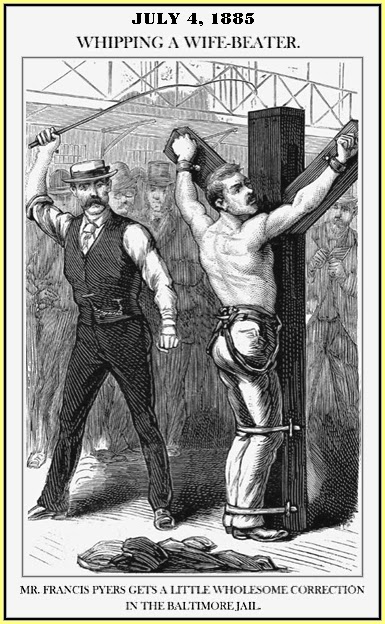
Many examples of vigilante justice, sometimes lethal, enacted against wifebeaters can be found in newspaper clippings from the 1800s and onward, with the full endorsement of society.
http://unknownmisandry.blogspot.com/2011/11/19th-century-intolerance-towards.html
http://unknownmisandry.blogspot.com/2011/10/societys-acceptance-of-domestic.html
We can assume that this was practiced in Europe as well. Likewise, Americans practiced shivaree and Europeans practiced charivari as a way to enable social censure of wifebeaters.
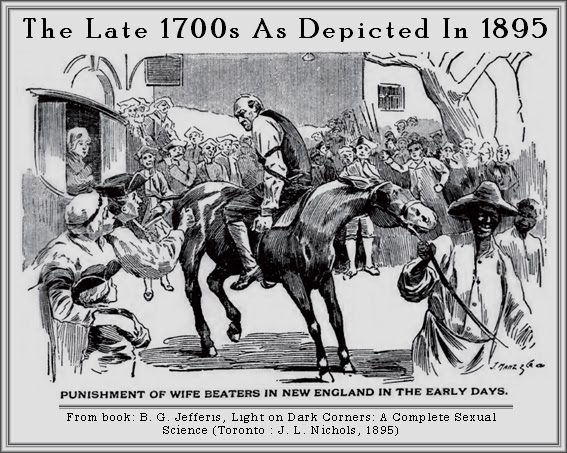
A charivari, also variously called a skimmington ride and riding the stang, is a historical folk custom expressing public disapproval of personal behavior.
Domestic violence was a common motive for a charivari. A man who beat his wife in southern England early in the nineteenth century could awaken at night to a noisy crowd, dancing in a frenzy around a bonfire outside his door. They would be “a motley assembly with hand-bells, gongs, cow-horns, whistles, tin kettles, rattles, bones, {and} frying-pans.” An orator would identify the wife-beater’s house with a signal chant:
There is a man in this place
Has beat his wife!!
Has beat his wife!!
It is a very great shame and disgrace
To all who live in this place,
It is indeed upon my life!!
Sometimes the crowd would carry an effigy of the targeted man to a substitute punishment, e.g. burning. Sometimes the man who physically abused his wife would be abused by the community:
Old Abram Higback has been paying his good woman; But he neither paid her for what or for why, But he up with his fist and blacked her eye.
Now all ye old women, and old women kind, Get together, and be in a mind; Collar him, and take him to the shit-house, And shove him over head.
Now if that does not mend his manners, The skin of his arse must go to the tanners; And if that does not mend his manners, Take him and hang him on a nail in Hell.
And if the nail happens to crack, Down with your flaps, and at him piss.
Husbands who were beaten by wives could also receive a charivari for essentially allowing it to happen.
Samuel Pepys recorded in his diary, 10 June 1667: “in the afternoon took boat and down to Greenwich, where I find the stairs full of people, there being a great riding there to-day for a man, the constable of the town, whose wife beat him.”[4] A Frenchman who traveled in England reported in 1698:
I have sometimes met in the streets of London a woman carrying a figure of straw representing a man, crown’d with very ample horns, preceded by a drum, and followed by a mob, making a most grating noise with tongs, grid-irons, frying-pans, and sauce-pans. I asked what was the meaning of all this; they told me that a woman had given her husband a sound beating, for accusing her of making him a cuckold, and that upon such occasions some kind neighbour of the poor innocent injur’d creature generally performed this ceremony. https://www.purplemotes.net/2013/01/27/charivari-sex-inequality/
Chants from the crowd were also made for this setting.
“With a ran, tan, tan,
On my old tin can,
Mrs. _ and her good man.
She bang’d him, she bang’d him,
For spending a penny when he stood in need.
She up with a three-footed stool;
She struck him so hard, and she cut so deep,
Till the blood run down like a new stuck sheep!”
https://en.wikipedia.org/wiki/Charivari
Note the difference between the chants given to a wifebeating charivari to a husband beating. In the first, the description of the violence done is meant to incite anger and revulsion from the crowd. In the second, the description of violence is to incite laughter and humiliation for the man, even though the violence described is greater.
From the violence given we also can know that this is not about thinking of women as weak and helpless. It’s that the husband wasn’t strong enough to stand up to a woman.
Again, we would assume that this idea could only stem from placing men in authority over women as a culture, yet a similar sentiment is given by a female commenter on a Jezebel post reacting to the finding that 70% of non-reciprocal intimate partner violence is perpetrated by women.
She wrote, “once dated an alcoholic (rite of passage for all good little girls) who came over drunk and got in my face. I punched him hard enough to knock him on his ass. After I dumped him, he served me with a restraining order, which I proudly showed off to all his friends. Stupid wimp.”
Another woman writes: “I too dated a pussy-ass alky, who tried to shove me around one drunken night. I kicked his ass, then promptly broke up with him. Not only because he was a drunk but because I’m only 5’4″ and 101 lbs., and I don’t want a man whose ass I can kick.”
You can find many other comments from women who gloat about the violence they perpetrated against their significant others, and how much those guys “totally deserved it.” https://jezebel.com/have-you-ever-beat-up-a-boyfriend-cause-uh-we-have-294383
Another example of the tradition can be seen in ‘Le Vilain Mire’, “a thirteenth-century Old French fabliau, which represents imaginatively charivari for domestic violence. A rich peasant won with his wealth the hand of an impoverished knight’s daughter. Fearing that he would be cuckolded while he was out working in the fields, the peasant resolved to beat his wife in the morning so that she would weep all day and not be attractive to men. When he returned home in the evening, the peasant planned to make up with her and enjoy marital life. After getting beaten twice, the wife ingeniously prompted the king’s messengers to beat her husband repeatedly. The king’s messengers found the husband, beat him for the first time, and then “they mounted him on a horse, his face to the tail, and led him to the king.” That’s the characteristic charivari position of a man being publicly shamed for beating his wife, or getting beaten by his wife. ” https://www.purplemotes.net/2013/06/23/domestic-violence-fabliau-farce/
The joke of the tale is that the man deserves his position on the horse for beating his wife and being beaten by her. Even though the wife never beat the husband in person, she beat him with other persons and therefore the man placed in the position for charivari is well-deserved. It also points to the idea that wifebeating wasn’t supported by the culture, since this tale would make no sense to us if we did not root for the wife and pity her for her husband beating her.
There is a belief that because men had a legal allowance to physically correct their wives, the reverse never happened. Although it is true that there were no legal sanctions for wives to beat their husbands, it is evident that there was a completely different response from society when they did. Court records show wives complaining about domestic violence but not the reverse, yet we know from how abuse plays out today as well as the many examples of female on male abuse we find in historical stories that this does not mean women did not enact domestic abuse on their husbands. It means the husband did not feel like he would receive help from the court, a similar feeling many men feel today in response to their abusive partners.
The view of women beating up men back then was the same as it is today, that it is a comical thing, no matter the severity, and that if the man can be beaten up by a woman, then he is not really worthy of being a husband or a man in the first place.
This is strikingly different from what we would expect from a typical superior/inferior relationship. A king could physically punish a subject with impunity, but if that subject tried to harm the king even with a mere slap to the face? The offense would be so great he could easily be killed for such a thing. He would deserve some kind of punishment.
But with husbands and wives, the husband was the main recipient for the punishment even though he was also the victim. Although sometimes the wife was included, the husband was always the one who would ride on the back of a donkey or wooden horse to be paraded around town as a comical figure. Women did not receive this treatment when beaten by their husbands.
In this way, we can say that husbands had restrictions placed on how much they could physically correct their wives; wives had far less limitations. If a woman beat up her husband, no matter how severely, he could only legally respond by chastising her with a light whipping with a belt or a thin stick. If he were to beat her beyond those means, he would face legal and social punishment.
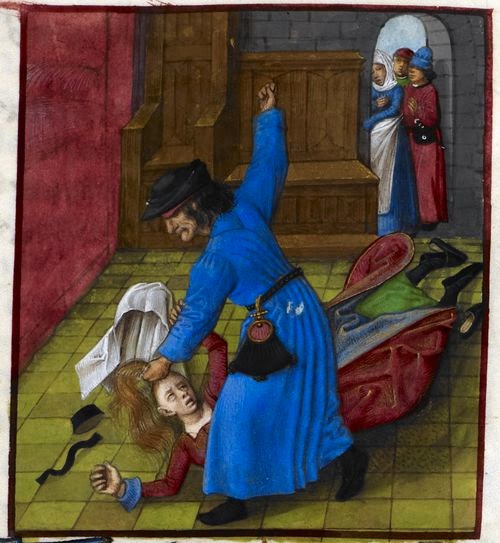
Cultural View of Domestic Violence in Media
Another essential aspect we must look at is media representations of domestic violence in the past. Afterall, laws can only provide us with one viewpoint of how things were dealt with and there is a widespread notion that violence against women by their husbands was culturally accepted and tolerated up until 1960 or so.
There is strong evidence from historical plays and fiction that it was just the opposite. Suffice it to say, these examples couldn’t have existed in a culture that widely accepted wifebeating or even minor violence to wives from husbands.
Othello by William Shakespeare, written 1603
Desdemona: Why, sweet Othello-
Othello: (striking her) You devil!
Desdemona: I haven’t done anything to deserve this!
Lodovico: My lord, no one will believe this in Venice, even though I’d swear I’d seen it with my own eyes. That was too much. You should apologize. She’s crying…. [Othello exits] Is this the same Moor whom the senate considers so capable? Is this the guy who’s supposed to never get emotional, and who never gets rattled, no matter what disaster happens?
IAGO He’s changed a great deal.
LODVICO Is he sane? Is he losing his mind?
IAGO He is what he is. I won’t say anything negative about what he might be. If he isn’t what he might be, then I wish to God he were!
LODOVICO Hitting his wife?
IAGO It’s true, that wasn’t such a nice thing to do. But I wish I could say that’s the last time he’ll do it!
LODOVICO Is it a habit of his? Or did the letter make him emotional somehow And new-create his fault? (and prompt for the first time this fault?)
IAGO Oh, it’s too bad! It wouldn’t be right for me to tell you everything I’ve seen and heard. You’ll see what he’s like. His own actions will show you what kind of person he is, so I won’t have to bother telling you. Just go after him and watch what he does next.
LODOVICO I’m sorry I was so wrong about him.
https://www.sparknotes.com/nofear/shakespeare/othello/page_212/
The Wife of Bath, 1386
“Well, when I realized that he was never going to stop saying such things, I got so angry that I ripped three pages out of the book, right there as he was reading it. I also punched him in the face with my fist so hard that he fell backward into the fire in the fireplace. He sprang up like a pouncing lion and punched me right back on the side of my head so hard that I fell down and didn’t move, just as if I were dead. And when he saw what he had done and thought he’d killed me, he was so horrified that he would have run away had I not come to just then. ‘Are you trying to kill me, you murderer? Are you going to kill me so that you can have all my money and land? Even so, let me kiss you one last time before I die.’
“He came over to me, knelt down, and said, ‘What have I done? My dear wife, Alison, so help me God, I’ll never hit you again. Please forgive me. I beg you.’ As he said this, though, I punched him in the face once again and said, ‘Take that, you bastard. I’m dying and can’t talk anymore.’ But, after much care and some more fighting, I finally recovered, and Jankin and I worked things out. He put me in charge of our household and over all our money and property, and he also promised that he wouldn’t say such horrible things about women or hit me again. And I made him burn that horrid book too. He told me, ‘Alison, do whatever you want with your life, and I leave it to you to do what’s best for the both of us.’ And when I’d finally won complete freedom and control over my own affairs and destiny, we never had reason to fight again. In fact, I am now a better wife to him than any woman between Denmark and India has ever been. And he became an equally excellent husband.”
https://www.sparknotes.com/nofear/lit/the-canterbury-tales/wife-of-baths-prologue/page_25/
We currently live in a culture where in almost every t.v. show or movie, there will be at least one example of a woman enacting violence on a man, frequently a potential suitor, boyfriend, or husband, and it is always portrayed as comical or justly deserved. There are many examples of this in historical literature as well. What we do not find is what we would expect from a supposedly patriarchal, misogynistic culture- that in almost every play or story, a man enacts violence against a woman, frequently his lover, girlfriend, or wife, and it is portrayed as comical or justly deserved. In many examples, as shown above, a man simply hitting his wife once was portrayed as an egregious act on his part. In others, the husband and wife engage in a mutual violence that is portrayed as comical, particularly when the wife wins against the husband.
“Mino dashed over to his wife and started battering her. “So you heaped shame on me and now you’re making fun of me?” Feeling the blows, the woman, who was much more robust than Mino , began to hit him back. What with one blow and another, Mino was soon down on the floor with his wife on top of him, giving him a good hiding.”
She said: “What are you talking about? Take it any way you like. You get drunk in this place and that, then you come home and call me a whore. I’ll beat you harder than Tessa beat her husband Calandrino the painter in Boccaccio’s story.”… Finding himself getting the worst of it, Mino asked his wife to let him get up and to stop yelling, so the neighbors wouldn’t hear the noise, run in to help, and find his wife straddling him. Hearing this, his wife said: “I’d like the whole neighborhood to be here!” She got up, allowing Mino to do the same. His face was all bruised. To quiet things down, he asked his wife to forgive him….To everyone in Siena that asked what had happened to his face, he said a crucifix had fallen on it. Now it came about that, for his own good, he did no more about the matter, saying to himself: “What a fool I am! I had six crucifixes and I still have six! I had a wife and I still have one, though I wish I didn’t! If I stir up trouble, I’ll only add to the harm that came to me this time. If she’s determined to be a slut, no one in the world can make her mend her ways.”
The wife who beats up her husband, through herself or by proxy, and thus subjects him to her will is a popular theme in medieval tales. From the earlier examples of The Wife of Bath or Le Vilain Mire, we can note that the women in these tales are not portrayed as evil or villains, but usually the character we root for.
“As Calandrino was now offering to kiss Niccolosa perforce, up came Nello with Dame Tessa and said, as soon as he reached the place, ‘I vow to God they are together.’ Then, coming up to the door of the barn, the lady, who was all a-fume with rage, dealt it such a push with her hands that she sent it flying, and entering, saw Niccolosa astride of Calandrino. The former, seeing the lady, started up in haste and taking to flight, made off to join Filippo, whilst Dame Tessa fell tooth and nail upon Calandrino, who was still on his back, and clawed all his face; then, clutching him by the hair and haling him hither and thither, ‘Thou sorry shitten cur,’ quoth she, ‘dost thou then use me thus? Besotted dotard that thou art, accursed be the weal I have willed thee! Marry, seemeth it to thee thou hast not enough to do at home, that thou must go wantoning it in other folk’s preserves? A fine gallant, i’faith! Dost thou not know thyself, losel that thou art? Dost thou not know thyself, good for nought? Wert thou to be squeezed dry, there would not come as much juice from thee as might suffice for a sauce. Cock’s faith, thou canst not say it was Tessa that was presently in act to get thee with child, God make her sorry, who ever she is, for a scurvy trull as she must be to have a mind to so fine a jewel as thou!'”
“Calandrino, seeing his wife come, abode neither dead nor alive and had not the hardihood to make any defence against her; but, rising, all scratched and flayed and baffled as he was, and picking up his bonnet, he fell to humbly beseeching her leave crying out, an she would not have him cut in pieces, for that she who had been with him was the wife of the master of the house; whereupon quoth she, ‘So be it, God give her an ill year.’ At this moment, Bruno and Buffalmacco, having laughed their fill at all this, in company with Filippo and Niccolosa, came up, feigning to be attracted by the clamour, and having with no little ado appeased the lady, counselled Calandrino betake himself to Florence and return thither no more, lest Filippo should get wind of the matter and do him a mischief. Accordingly he returned to Florence, chapfallen and woebegone, all flayed and scratched, and never ventured to go thither again; but, being plagued and harassed night and day with his wife’s reproaches, he made an end of his fervent love, having given much cause for laughter to his companions, no less than to Niccolosa and Filippo.”
http://www.gutenberg.org/files/23700/23700-h/23700-h.htm#THE_FIFTH_STORY9
These stories are frequently written by men, and though this is enough to justify their inherent misogyny in the minds of feminists, I find it more accurate to see it as reactions by men to the prescribed historical social norms. You expect me to be the one in charge? Let me tell you a story about how often it’s really wives in charge. You say men are the only ones who become violent? Let me tell you a story about how women are violent.
This is particularly important to note as we consider the examples of stories that do show wifebeating as acceptable and positive. There are only a few, so it is clear that this was not a popular notion, but rather a reaction to the popular notion which was that beating one’s wife was not acceptable.
The first story I’ll mention has some variations from different cultures, so it was passed around. Here is one:
The Language of Beasts
A shepherd helps a snake and receives the magical ability to understand the language of animals, however if he tells anyone about it, he will immediately die.
So the shepherd set out for home, and on his way through the wood he heard and understood all that was said by the birds, and by every living creature. When he got back to his sheep he found the flock grazing peacefully, and as he was very tired he laid himself down by them to rest a little.
Hardly had he done so when two ravens flew down and perched on a tree nearby, and began to talk to each other in their own language, “If that shepherd only knew that there is a vault full of gold and silver beneath where that lamb is lying, what would he not do?”
When the shepherd heard these words he went straight to his master and told him, and the master at once took a wagon, and broke open the door of the vault, and they carried off the treasure. But instead of keeping it for himself, the master, who was an honorable man, gave it all up to the shepherd, saying, “Take it, it is yours. The gods have given it to you.”
So the shepherd took the treasure and built himself a house. He married a wife, and they lived in great peace and happiness, and he was acknowledged to be the richest man, not only of his native village, but of all the countryside. He had flocks of sheep, and cattle, and horses without end, as well as beautiful clothes and jewels.
One day, just before Christmas, the shepherd said to his wife, “Prepare everything for a great feast, tomorrow we will take things with us to the farm that the shepherds there may make merry.”
The wife obeyed, and all was prepared as he desired. Next day they both went to the farm, and in the evening the master said to the shepherds, “Now come, all of you, eat, drink, and make merry. I will watch the flocks myself tonight in your stead.” Then he went out to spend the night with the flocks.
When midnight struck the wolves howled and the dogs barked, and the wolves spoke in their own tongue, saying, “Shall we come in and work havoc, and you too shall eat flesh?”
And the dogs answered in their tongue, “Come in, and for once we shall have enough to eat.”
Now amongst the dogs there was one so old that he had only two teeth left in his head, and he spoke to the wolves, saying, “So long as I have my two teeth still in my head, I will let no harm be done to my master.”
All this the master heard and understood, and as soon as morning dawned he ordered all the dogs to be killed excepting the old dog. The farm servants wondered at this order, and exclaimed, “But surely, sir, that would be a pity?”
The master answered, “Do as I bid you”; and made ready to return home with his wife, and they mounted their horses, her steed being a mare. As they went on their way, it happened that the husband rode on ahead, while the wife was a little way behind.
The husband’s horse, seeing this, neighed, and said to the mare, “Come along, make haste; why are you so slow?”
And the mare answered, “It is very easy for you, you carry only your master, who is a thin man, but I carry my mistress, who is so fat that she weights as much as three.”
When the husband heard that he looked back and laughed, which the wife perceiving, she urged on the mare till she caught up with her husband, and asked him why he laughed.
“For nothing at all,” he answered; “just because it came into my head.”
She would not be satisfied with this answer, and urged him more and more to tell her why he had laughed. But he controlled himself and said, “Let me be, wife; what ails you? I do not know myself why I laughed.”
But the more he put her off, the more she tormented him to tell her the cause of his laughter. At length he said to her, “Know, then, that if I tell it you I shall immediately and surely die.” But even this did not quiet her; she only besought him the more to tell her.
Meanwhile they had reached home, and before getting down from his horse the man called for a coffin to be brought; and when it was there he placed it in front of the house, and said to his wife, “See, I will lay myself down in this coffin, and will then tell you why I laughed, for as soon as I have told you I shall surely die.”
So he lay down in the coffin, and while he took a last look around him, his old dog came out from the farm and sat down by him, and whined. When the master saw this, he called to his wife, “Bring a piece of bread to give to the dog.”
The wife brought some bread and threw it to the dog, but he would not look at it. Then the farm cock came and pecked at the bread; but the dog said to it, “Wretched glutton, you can eat like that when you see that your master is dying?”
The cock answered, “Let him die, if he is so stupid. I have a hundred wives, which I call together when I find a grain of corn, and as soon as they are there I swallow it myself; should one of them dare to be angry, I would give her a lesson with my beak. He has only one wife, and he cannot keep her in order.”
As soon as the man understood this, he got up out of the coffin, seized a stick, and called his wife into the room, saying, “Come, and I will tell you what you so much want to know”; and then he began to beat her with the stick, saying with each blow, “It is that, wife, it is that!” And in this way he taught her never again to ask why he had laughed.
https://www.pitt.edu/~dash/type0670.html
There are many things to note here. There is a theme of the lord and vassal type relationship, such as the shepherd when he discovers the existence of a hidden treasure trove, does not keep it for himself, but tells his master so that he could take it. His master kindly gives it to him, freeing him from his servitude. The old dog, a widely acknowledged symbol for loyalty, though wolves are at his master’s door, states that he will protect his master’s life with his own even though he has only two teeth left. The shepherd himself, at first, is also ready to die just to give in to his wife’s desires, pointing to the idea that he is showing his loyalty to her and perhaps that she is the lord and he the vassal in the relationship. In contrast, the shepherd’s wife is presented as uncaring of her husband’s life and that it mattered more to her that she should learn of a trivial matter even if it meant that her husband should die.
Although as a folktale the circumstances of this story are fantastical and imaginary, the theme points to a feeling that perhaps many men have experienced, especially in connection to the women in their lives: that their lives are often treated carelessly for even trivial objectives demanded by women. It brings to mind the World War II veteran who talked about his mother and wife fighting over who would get the payout from the army should he die in war. Or the woman who argues with some thug on the street, secure in the knowledge that if a fight breaks out, it’s her boyfriend who will have to step in while she safely steps out.
The underlying theme of these stories is a response to the expectation of male disposability, especially when demanded by women. The male characters aren’t opposed to dying for the sake of others, but express a desire for those who depend on it not to demand it unnecessarily.
This is illustrated more clearly in an excerpt from another similar tale:
“It happened that an old goat and his wife were browsing in the neighbourhood, and, as the king and queen sat there, the nanny goat came to the well’s brink and peering over saw some lovely green leaves that sprang in tender shoots out of the side of the well. “Oh!” cried she to her husband, “come quickly and look. Here are some leaves which make my mouth water; come and get them for me!”
Then the billy goat sauntered up and looked over, and after that he eyed his wife a little crossly. “You expect me to get you those leaves, do you? I suppose you don’t consider how in the world I am to reach them? You don’t seem to think at all; if you did you would know that if I tried to reach those leaves I should fall into the well and be drowned!”
“Oh,” cried the nanny goat, “why should you fall in? Do try and get them!”
“I am not going to be so silly,” replied the billy goat. But the nanny goat still wept and entreated.
“Look here,” said her husband, “there are plenty of fools in the world, but I am not one of them. This silly king here, because he can’t cure his wife of asking questions, is going to throw his life away. But I know how to cure you of your follies, and I’m going to.” And with that he butted the nanny goat so severely that in two minutes she was submissively feeding somewhere else, and had made up her mind that the leaves in the well were not worth having.”
https://www.pitt.edu/~dash/type0670.html#langolive
The main character in these tales is at first willing to die in order to satisfy his spouse’s trivial, completely unnecessary request, and another character reminds him that this should not be so. This could have wide ranging meanings such as a tendency amongst wives to demand their husband work harder and harder in order to earn more money to be able to buy nicer, if unnecessary, things. A nicer home, grander furnishings, more servants, finer clothes, etc.
There is one last type of tale which shows wifebeating in a positive light and its ultimate theme is that for some wives, who are lazy and rude and don’t do their work, beating is the only way to make them behave. These tales are earlier forms of The Taming of the Shrew. Because they take place in a setting in which the man reluctantly engages in it and where his neighbors initially oppose it, we can still infer that this is not a belief that is widely accepted by the culture.
Accordingly, they fared on and came, after some days, to Antioch, where Giosefo kept Melisso with him, that he might rest himself a day or two, and being scurvily enough received of his wife, he bade her prepare supper according as Melisso should ordain; whereof the latter, seeing that it was his friend’s pleasure, acquitted himself in a few words. The lady, as her usance had been in the past, did not as Melisso had ordained, but well nigh altogether the contrary; which Giosefo seeing, he was vexed and said, ‘Was it not told thee on what wise thou shouldst prepare the supper?’ The lady, turning round haughtily, answered, ‘What meaneth this? Good lack, why dost thou not sup, an thou have a mind to sup? An if it were told me otherwise, it seemed good to me to do thus. If it please thee, so be it; if not, leave it be.’ Melisso marvelled at the lady’s answer and blamed her exceedingly; whilst Giosefo, hearing this, said, ‘Wife, thou art still what thou wast wont to be; but, trust me, I will make thee change thy fashion.’ Then turning to Melisso, ‘Friend,’ said he, ‘we shall soon see what manner of counsel was Solomon’s; but I prithee let it not irk thee to stand to see it and hold that which I shall do for a sport. And that thou mayest not hinder me, bethink thee of the answer the muleteer made us, when we pitied his mule.’ Quoth Melisso, ‘I am in thy house, where I purpose not to depart from thy good pleasure.’
Giosefo then took a round stick, made of a young oak, and repaired a chamber, whither the lady, having arisen from table for despite, had betaken herself, grumbling; then, laying hold of her by the hair, he threw her down at his feet and proceeded to give her a sore beating with the stick. The lady at first cried out and after fell to threats; but, seeing that Giosefo for all that stinted not and being by this time all bruised, she began to cry him mercy for God’s sake and besought him not to kill her, declaring that she would never more depart from his pleasure. Nevertheless, he held not his hand; nay, he continued to baste her more furiously than ever on all her seams, belabouring her amain now on the ribs, now on the haunches and now about the shoulder, nor stinted till he was weary and there was not a place left unbruised on the good lady’s back. This done, he returned to his friend and said to him, ‘To-morrow we shall see what will be the issue of the counsel to go to Goosebridge.’ Then, after he had rested awhile and they had washed their hands, he supped with Melisso and in due season they betook themselves to bed.
Meanwhile the wretched lady arose with great pain from the ground and casting herself on the bed, there rested as best she might until the morning, when she arose betimes and let ask Giosefo what he would have dressed for dinner. The latter, making merry over this with Melisso, appointed it in due course, and after, whenas it was time, returning, they found everything excellently well done and in accordance with the ordinance given; wherefore they mightily commended the counsel at first so ill apprehended of them.”
http://www.gutenberg.org/files/23700/23700-h/23700-h.htm#THE_NINTH_STORY9
Another example of this story can be found here, it uses far more violence, but appears to be obscure, so therefore, highly unpopular at any time: https://books.google.com/books?id=qZ68AQAAQBAJ&pg=PT234&dq=Brother+michele&hl=en&sa=X&ved=2ahUKEwio9qWk5qHiAhV7JzQIHfXkBzQQ6AEwAHoECAMQAg#v=onepage&q=Brother%20michele&f=false
One could say that the earlier examples of The Wife of Bath, Calandrino and Tessa, and The Walking Crucifix showcased a similar theme but with the genders reversed. And it probably didn’t occur to you to think of those as one of the most egregious stories of all time because the violence was happening to the husband, not the wife.
Though these stories come close to tired tropes of the idea of domestic violence, such as the husband who comes home to find his wife has not made dinner in a way that pleased him as well as the disobedient wife who didn’t serve her husband like a servant to a king, we must remember that wives and husbands had expected duties to each other and their families.
What were the responsibilities of a husband? As mentioned above in the court case between Sitella and Giulielino, to earn money, provide necessities like food, drink, shelter, clothes, and to keep his family comfortable according to his means and equal to his status in life. What were the responsibilities of a wife? To cook, clean, tend to the children, and generally keep the household in order- but only if a servant could not be procured to do this for her. This is why Sitella is able to demand that her husband provide a servant for her, because they are well off enough that he can afford to do so and to make her work to do those chores is beneath their status in life and could be considered maltreatment of her. Poorer husbands however could expect that their wives should cook and clean, and a wife who did not do this wasn’t fulfilling her expected duties. Likewise, a husband who did not work when he must in order to earn money for the family was not fulfilling his expected duties. Note that rich wives, whose husbands could afford servants to take over all of these duties for their wives, including nannies and nursemaids to care for the children as well as housekeepers to run the house, essentially had no responsibilities at all. Yet, rich husbands would still have the responsibility of ensuring the family had enough money so that he could provide necessities according to his station.
These stories, the only ones I found which showed positive views of wifebeating, were written in medieval times, but the idea that some people just won’t learn or behave without the application of violence continued until recently. We don’t find these other other examples incendiary because they don’t involve wives, they involve children, specifically boys, and men.
In the Anne of Green Gables series written in the early 1900s, Anne as a school teacher early on opposes using any corporeal punishment on her students because she doesn’t believe in using it at all.
“The main thing will be to keep order and a teacher has to be a little cross to do that. If my pupils won’t do as I tell them I shall punish them.”
“How?”
“Give them a good whipping, of course.”
“Oh, Jane, you wouldn’t,” cried Anne, shocked. “Jane, you couldn’t!”
“Indeed, I could and would, if they deserved it,” said Jane decidedly.
“I could never whip a child,” said Anne with equal decision. “I don’t believe in it at all. Miss Stacy never whipped any of us and she had perfect order; and Mr. Phillips was always whipping and he had no order at all. No, if I can’t get along without whipping I shall not try to teach school. There are better ways of managing. I shall try to win my pupils’ affections and then they will want to do what I tell them.”
“But suppose they don’t?” said practical Jane.
“I wouldn’t whip them anyhow. I’m sure it wouldn’t do any good. Oh, don’t whip your pupils, Jane dear, no matter what they do.”
“What do you think about it, Gilbert?” demanded Jane. “Don’t you think there are some children who really need a whipping now and then?”
“Don’t you think it’s a cruel, barbarous thing to whip a child. . . any child?” exclaimed Anne, her face flushing with earnestness.
“Well,” said Gilbert slowly, torn between his real convictions and his wish to measure up to Anne’s ideal, “there’s something to be said on both sides. I don’t believe in whipping children much. I think, as you say, Anne, that there are better ways of managing as a rule, and that corporal punishment should be a last resort. But on the other hand, as Jane says, I believe there is an occasional child who can’t be influenced in any other way and who, in short, needs a whipping and would be improved by it. Corporal punishment as a last resort is to be my rule.”
Gilbert, having tried to please both sides, succeeded, as is usual and eminently right, in pleasing neither.
But one of her pupils proves to be obstinate and rude enough that she beats him with her pointer, and after that he minds his manners.
Anne paid no attention to the wretched Joseph. She looked at Anthony Pye, and Anthony Pye looked back unabashed and unashamed.
“Anthony, was it you?”
“Yes, it was,” said Anthony insolently.
Anne took her pointer from her desk. It was a long, heavy hardwood pointer.
“Come here, Anthony.”
It was far from being the most severe punishment Anthony Pye had ever undergone. Anne, even the stormy-souled Anne she was at that moment, could not have punished any child cruelly. But the pointer nipped keenly and finally Anthony’s bravado failed him; he winced and the tears came to his eyes.
Anne, conscience-stricken, dropped the pointer and told Anthony to go to his seat. She sat down at her desk feeling ashamed, repentant, and bitterly mortified. Her quick anger was gone and she would have given much to have been able to seek relief in tears. So all her boasts had come to this. . .she had actually whipped one of her pupils. How Jane would triumph! And how Mr. Harrison would chuckle! But worse than this, bitterest thought of all, she had lost her last chance of winning Anthony Pye. Never would he like her now.
Anne, by what somebody has called “a Herculaneum effort,” kept back her tears until she got home that night. Then she shut herself in the east gable room and wept all her shame and remorse and disappointment into her pillows. . .wept so long that Marilla grew alarmed, invaded the room, and insisted on knowing what the trouble was.
“The trouble is, I’ve got things the matter with my conscience,” sobbed Anne. “Oh, this has been such a Jonah day, Marilla. I’m so ashamed of myself. I lost my temper and whipped Anthony Pye.”
“I’m glad to hear it,” said Marilla with decision. “It’s what you should have done long ago.”
…Owing to the snow she had to go around by the road to school and she thought it was certainly an impish coincidence that Anthony Pye should come ploughing along just as she left the Green Gables lane. She felt as guilty as if their positions were reversed; but to her unspeakable astonishment Anthony not only lifted his cap. . .which he had never done before. . .but said easily,
“Kind of bad walking, ain’t it? Can I take those books for you, teacher?”
Anne surrendered her books and wondered if she could possibly be awake. Anthony walked on in silence to the school, but when Anne took her books she smiled down at him. . .not the stereotyped “kind” smile she had so persistently assumed for his benefit but a sudden outflashing of good comradeship. Anthony smiled. . .no, if the truth must be told, Anthony grinned back. A grin is not generally supposed to be a respectful thing; yet Anne suddenly felt that if she had not yet won Anthony’s liking she had, somehow or other, won his respect.
Mrs. Rachel Lynde came up the next Saturday and confirmed this.
“Well, Anne, I guess you’ve won over Anthony Pye, that’s what. He says he believes you are some good after all, even if you are a girl. Says that whipping you gave him was `just as good as a man’s.'”
“I never expected to win him by whipping him, though,” said Anne, a little mournfully, feeling that her ideals had played her false somewhere. “It doesn’t seem right. I’m sure my theory of kindness can’t be wrong.”
“No, but the Pyes are an exception to every known rule, that’s what,” declared Mrs. Rachel with conviction.
Mr. Harrison said, “Thought you’d come to it,” when he heard it, and Jane rubbed it in rather unmercifully.
As you can see, this story followed the exact form as above, but was written just 100 years ago and in application to children. The Anne of Green Gables series is not reviled for this scene. Somehow, reading this story, I bet you don’t feel that bad for the boy and you probably don’t feel that it was totally undeserved.
I certainly don’t advocate for this view, I merely want to point out the hypocrisy of thinking one is acceptable over the other. This is a tendency we have for men, that they are the appropriate receptacles for violence and never women.
Likewise, feminists are adamant that violence against men is the only way to teach them.
“We break windows, we burn things, because war is the only language men listen to!” -Suffragette, 2015
https://jezebel.com/have-you-ever-beat-up-a-boyfriend-cause-uh-we-have-294383
But even if we want to dismiss these last stories for justifying any violence towards a woman, we must take into consideration that these are the few that do. In comparison, nearly every t.v. show and movie portrays violence from women to men including in relationships as justified, even if it is merely because he said something to her that she disliked. If men had this same ability to women in the past, we would see it as commonly in their fiction as we see violence against men in our media today, but we do not. What we see is that men had a fraction of the social allowance for violence enacted against the opposite sex that is given to women today.
Is every instance of violence, even if small, to another person an egregious offense that should never be forgiven or tolerated? I don’t know. It seems to me that in every other relationship, whether it be between siblings, friends, and even parent to child, there isn’t a zero tolerance for violence held by society. And as mentioned many times, we hold the view that many instances of violence can be considered acceptable so long as it is by a woman to a man.
We have to decide what is more right, that it is never acceptable to hit one’s partner or that it is understandable, even if not right, in some circumstances. If we truly want to better understand and diminish domestic violence, we have to see it for what it really is and how it really happens.
Today our sentiments about domestic violence, in reference to women, is that there should never be any tolerance for a man using the slightest of violence on a female partner; a man who ever hits a woman is an abuser so she needs to leave him immediately and he should probably be jailed for life. Considering that this is our standard, it is no wonder that it is so easy for us to condemn the past for holding anything less than this view. We currently demand absolute perfection from men, so even the slightest deviation from that is going to feel like failure. On the other hand, if a woman uses any minor to moderate violence with her husband, we wouldn’t automatically tell him to divorce her, or that she should go to jail, or that he even needs to leave her.
We have to decide what is the more acceptable view and apply it equally to both sexes. It is either right that there should be zero tolerance for a person ever becoming physical with their partner, or we should take into consideration frequency, severity, and setting. Emotional fighting can easily escalate to physical fighting, and if one partner engages in it, it is far more likely that the other partner will respond in kind.

 Unapologetically Anti-Feminist
One thought on “Correcting Notions About Domestic Violence in History”